Gasoline particulate filter
GPF / OPF / PPF delete by software
Software solution for competition, off-road use and countries where it is permitted. In Spain it is not legal to drive on public roads with the system deleted.
Find your distributorI'm a workshop: I want tuning files
Software solution
GPF / OPF / PPF system
Particulate filters for gasoline direct injection engines are needed to comply with the Euro 6 emission standard, which sets a limit of 6x10^11 particles per kilometer. They are separate devices from the catalytic converter, although they are usually located right after it.
Depending on driving style, filter regeneration takes place through a simpler process than in a diesel engine, because gasoline engines do not produce particles in every operating condition. In addition, due to their design principle, exhaust gas temperatures in spark-ignition engines are higher than in compression-ignition engines.
Thanks to the oxygen supply managed by the engine control unit and the resulting rise in exhaust system temperature, the load, which is clearly lower than in a diesel engine, lends itself easily to post-oxidation and neutralization.
When the after-treatment system fails and your vehicle is not required to have the system under applicable regulations, or it is a competition vehicle, ReproRACE.com offers a removal service through our network of distributors.
ReproRACE.com offers you this service
Visit a distributor in our sales NETWORK
Your GPF deleted by software, with no warning lights or limp mode
Find my nearest distributor
Legal notice:
ReproRACE provides a global electronic modification service in many countries around the world. Users must check the legal regulations in their own country. ReproRACE does not offer emission control system deletes where they are not legal; in those places, use is limited to competition vehicles that are not driven on public roads.
Delete the GPF system today
Find your distributor
Sign up
What is the GPF particulate filter?
Gasoline Particulate Filter / Otto Partikelfilter
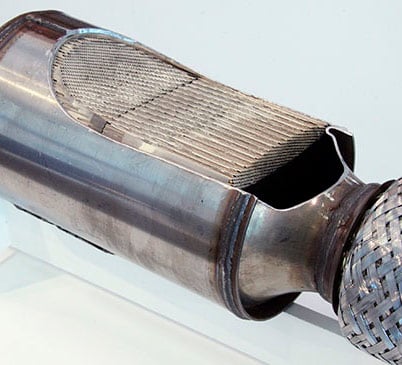
The GPF (Gasoline Particulate Filter), also known as OPF (Otto Partikelfilter) on German vehicles, is an emission control device installed in the exhaust system of modern gasoline vehicles. Its main function is to capture and store the soot particles produced during engine combustion.
This filter became mandatory for new gasoline vehicles in Europe from the Euro 6d-TEMP (2017) and Euro 6d (2020)standard. Its introduction responds to regulations on particulate emissions from direct injection (GDI) engines.
How the GPF works technically
The GPF works much like a diesel DPF. It consists of a silicon carbide ceramic substrate with alternating channels (wall-flow). The gases pass through the filter's porous walls, trapping the soot particles.
To prevent clogging, the system carries out regenerations. Passive regeneration occurs at high speed (600-650°C / 1,110-1,200°F). When that is not enough, the ECU activates active regeneration, modifying the injection maps to raise the exhaust temperature.
Legal notice:
ReproRACE provides a global electronic modification service in many countries around the world. Users must check the legal regulations in their own country. ReproRACE does not offer emission control system deletes where they are not legal; in those places, use is limited to competition vehicles that are not driven on public roads.
Common problems with the GPF
Clogging and saturation
In city driving, the filter does not reach regeneration temperatures. Particles build up and performance drops.
Frequent regenerations
They increase fuel consumption, dilute the oil with gasoline and produce extreme exhaust temperatures.
Loss of power
The GPF is a flow restriction. A clogged filter increases back pressure and the engine loses response.
Maintenance costs
Replacement: €1,500-3,000. Professional cleaning is not always effective.
When does a GPF delete make sense, and what are the alternatives?
A GPF, OPF or PPF delete by software only makes sense for gasoline vehicles that are not driven on public roads, such as competition or track cars, or in countries whose regulations allow it. On a street car, a filter warning is almost always resolved with a regeneration or by repairing a sensor.
| Situation | What is usually behind it | What to do |
|---|
| Filter warning after many short trips with a cold engine | Soot buildup: the filter has not reached temperature | Drive for a while at a steady speed so it regenerates |
| The warning comes back even after long drives | Differential pressure sensor or its hoses | Read the fault codes and check the sensor before replacing the filter |
| Check engine light on | A stored fault that may not be related to the filter | Diagnose the warning light without clearing the code |
| Competition vehicle with a modified exhaust | The filter is not mandatory for that use | Software delete with a calibration specific to the engine |
What is the difference between GPF, OPF and PPF?
None: they are three names for the same component. GPF stands for gasoline particulate filter, OPF comes from the German Otto-Partikelfilter and PPF from the British English petrol particulate filter. Each manufacturer uses one or the other in its documentation.
Since when have gasoline cars had a particulate filter?
It became widespread around 2018, with the Euro 6d-TEMP phase, on gasoline direct injection engines. The gasoline particulate filter guide explains how it works and what faults it causes, and in which Euro standard my car meets you can check your vehicle's.
How does a GPF regenerate?
Almost always without the driver noticing. The exhaust of a gasoline engine runs hotter than a diesel's, and every time you lift off the throttle, oxygen reaches the hot filter and the soot burns off. That is why warnings mostly appear with very short trips and a cold engine.
What is changed in the ECU?
The calibration deactivates the filter monitoring and its diagnostics, and it is prepared for each engine and each ECU. Before starting, the vehicle's original file is saved, so you can always return to the stock software.
Is it legal to drive in Spain with the GPF removed?
No. Disabling or modifying emission control systems (particulate filter, EGR, AdBlue/SCR and similar) is not permitted on vehicles driven on public roads in the European Union and in many other countries. ReproRACE only offers these solutions where regulations allow it, for example for competition, use on private property or markets whose legislation permits it. In Spain, the ITV inspection reads the emission control system of Euro 5 and Euro 6 vehicles through OBD, and a disabled or tampered emission control system is grounds for a failed inspection; in addition, a power increase is a modification that must be legalized. When there is a fault, the first step is always to diagnose and repair. More information in is it legal to tune a car in Spain?
All the faults and codes explained are in the index of faults and fault codes.
Our results
+1.2K GPF
Vehicles
+300
Models
0
Errors
100%
Professional
Frequently asked questions
Is it legal to remove the GPF?
Removing the GPF on vehicles driven on public roads is illegal in most EU countries. This service is exclusively for competition, track use or territories where there are no regulations on tampering with the system.
What does the service include?
Complete ECU reprogramming: removal of fault codes, deactivation of regenerations, adjustment of diagnostic maps and sensors.
Will errors appear afterwards?
No. We deactivate all GPF fault codes (P2463, P244A, P2458, etc.). No warning lights on and no errors in diagnostics.
Is it reversible?
Yes. We keep the original file from your ECU. We can restore the original software whenever you need.
More guides: gasoline particulate filter (GPF), fault code guides.
Have questions? Contact us
Send
Are you a car enthusiast? ReproRACE offers
Free courses
Access our free training